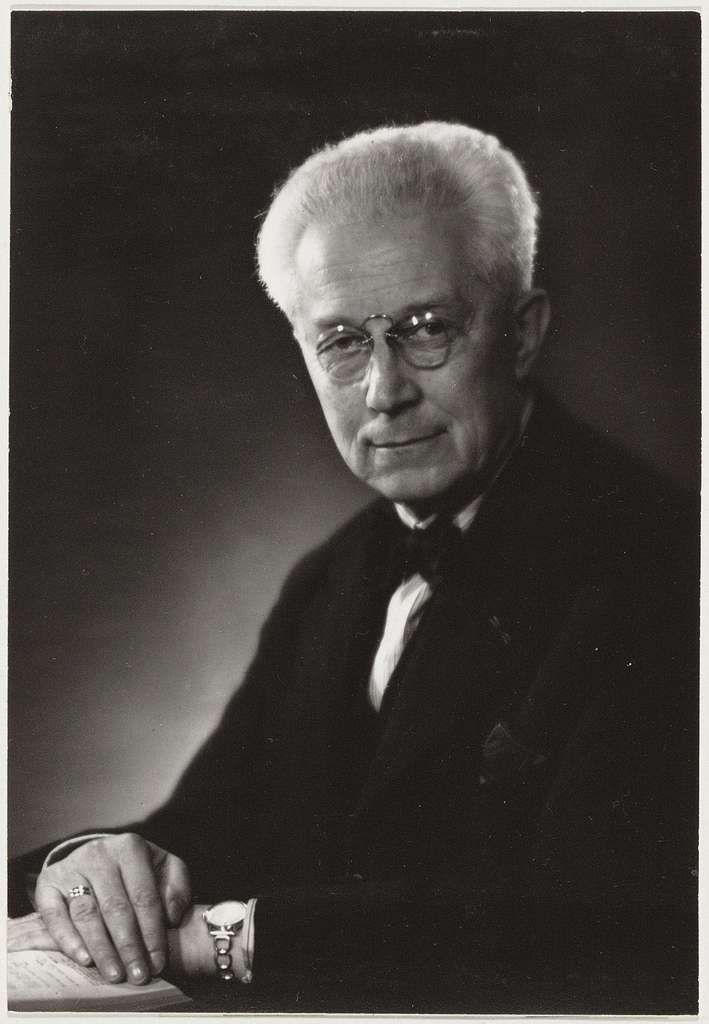
Born in Amsterdam, the Netherlands, on December 19, 1879, Théodore Limperg Jr. attended the Commercial High School—a typical preparation for students intending to find employment orcommence a career in private or corporate business—and graduated in 1897. Théodore Limperg Jr. then began to study for the national examination in advanced bookkeeping (accounting); he earned the certificate qualifying him for teaching bookkeeping and related subjects in high schools.
It is noteworthy that Théodore Limperg Jr. did not enroll as an accounting student in a university; he never earned a college degree. In the early twentieth century, there was no business administration program available in the Dutch universities. The rapid progress and the amazing accomplishments of this young accountant resulted from his deep interest in the accounting profession and his strong dedication to the development of a theory of business economics and business administration. His lack of higher education was more than compensated by an iron will that maintained him in an exacting schedule of selfstudy, continuing until late in life.
In 1901, three years before he passed the public accountants examination and gained admission to the Netherlands Institute of Accountants, Théodore Limperg Jr. was accepted as a member of Volmer and Co., a partnership of certified public accountants in Amsterdam. At that time (January 1901), he had just turned 21. Only two years later, the title of the partnership was changed to include his name (Nijst, Bianchi and Limperg), notwithstanding the fact that only Jules Nijst could sign for the firm. It was not until 1904 that Nijst’s copartners would be admitted to the Institute of Accountants. After the resignation of Nijst from the firm in 1905, the partnership continued with the name of Bianchi and Limperg. Later, Limperg practiced as a partner in the firm of Th. and L. Limperg.
In the meantime, Théodore Limperg Jr. had also become active elsewhere. In 1903 a new professional magazine for Dutch accountants, Accountancy, began publication; Théodore Limperg Jr. was one of its founders and a member of the editorial staff.
Before long, Limperg became the editor-in-chief, a post he held for 20 years. Under his guidance, the periodical became a powerful factor in the development of the accounting profession and the Netherlands Institute of Accounting. His contribution to the success of the magazine could easily be recognized by the new, innovative, and scholarly articles that appeared, with or without his signature. In 1924 the name of the magazine was changed to Monthly Journal of Accountancy and Business Administration. It is currently published under the name of Monthly Journal of Accountancy and Business Economics.
Conflicts with the “old guard” of the Netherlands Institute of Accounting developed on matters concerning the development of accounting and the regulation of the profession. Limperg would be patient when discussing innovative proposals, but he had a propensity to make his new ideas prevail, and when principles were involved, he was firm in his refusals to compromise. In 1906 his decision to publish an uncomfortable letter to the editor resulted in revocation of his membership in the Institute. But on the same day, Limperg and about 20 supporters organized their own Netherlands Accountants Association, which would grow to be a powerful force in developing accountancy in the Netherlands. The new group organized an educational program and an examination committee (headed by Limperg) for professional degree candidates.
In 1918 the institute and the association agreed to merge, and Limperg’s membership was reinstated. He became the chairman of the committee on examinations. All honors were bestowed on him. The Dutch accounting community had finally discovered his greatness.
The strong support Limperg had given to the teaching of accounting and business economics on the level of higher education contributed to the organization of a Department of Economics and Business Administration at the University of Amsterdam. Limperg accepted a professorship, teaching both undergraduate and graduate students in 1922. Accountancy, business economics, and business administration were studied within one comprehensive framework of social and business economics. He held that, essentially, the concepts and laws in all areas were identical; their scientific analysis should use deductive methods where appropriate. These ideas were in marked contrast to the pragmatic views of most accountants of the time, especially those held by the faculty of the Business Academy in Rotterdam.
Limperg’s opposition to the applicability of nominalism and the originalcost doctrine became widely understood. As the principal debaters about methodology and specific issues in accounting theory and practice began to be identified as members of the Amsterdam and the Rotterdam “schools,” the antagonism grew stronger. However, after the conclusion of World War II and after Limperg’s death, most of the controversy on the basic issues had disappeared.
The famous Limpergian postulate of continuity and his replacement-value theory are topics found in the extensive theoretical and practical Dutch literature, especially after the giant N.V. Philips Industries adopted replacement-valuation principles in its management and financial accounting. Still, in the Dutch business sector, the replacement-value concept has never found significant adoption.
In 1947 the Netherlands School of Economics (now Erasmus University) awarded Limperg a doctoral degree, honoris causa. Limperg retired from the university in 1949 but remained active as president of the Conseil International de l’Organisation Scientifique (CIOS) and as advisory board member of the Netherlands Institute of Efficiency (NIVE). He died on December 5, 1961.
Along with the writings of Fritz Schmidt and Eugen Schmalenbach, two of the foremost scholars in Germany, Limperg’s work marked the end of the predominance of nominalistic concepts among leading accounting theorists. The nominalist school of thought had held for many years that accounting data must be expressed in money units, measuring the transactions at the time of their origin; thus the maintenance of the original investment in terms of recorded money units was the accepted basis for determining income. Development of modern accounting theory in Europe and elsewhere has required the sophistication of talented and dedicated scholars to extend and refine the legacies of Limperg and his contemporaries. So far, the Dutch have done their share.
It is not clear why Limperg never wrote a book. His many articles and incidental presentations cover a diversity of topics; the writing is always strict and judicious, reflecting his extreme attention to detail and exactness, and often innovative and controversial. The “grand Limpergian theory,” written between 1922 and 1929, is a closed, stringent structure in which external and internal organization, accounting, finance, auditing, and labor relations were placed as specialized fields according to their function. This material was presented to his students in lectures that were meticulously edited and often innovative and controversial. The Limperg Instituut in Amsterdam has sponsored the publication of assembled course notes and related material under the title Bedriifseconomie, Verzameld Werk. A revised edition was published (in part) in 1976.
After Limperg’s death, his supporters continued to perfect and develop his theory. Several premises and conclusions have been questioned and a few are now abandoned. But the basic design has survived, and the great value of Limperg’s contribution to methodology and principles of accounting is widely acknowledged.